Journaling this morning these words came to me:
“Be a steward of your energy. Where you direct your focus becomes the experience of your life. Choose wisely.”
There’s a term called the “attention economy” which describes a system where attention, especially in the digital age, is a finite resource that companies compete to capture and retain, often using psychological principles to drive engagement. In the past handful of years it’s become increasingly clear that Facebook, Instagram, TikTok, YouTube, etc are to be carefully managed. They can be toxic sources of distraction, fear, and polarization. They can also be fun, connecting, wonderful places of discovery. The access to both sides of this spectrum is heightened and simultaneous. Choose wisely what to follow, watch, and injest. As a child, my mother used to say to me “be careful what you’re putting in your mind”. These words ring so true.
Consider also that there are many other sources of distraction, fear, and negativity in our everyday lives. It need not be limited to the device in your hand. There can be devastating conditions in the news, in your neighboring state, country, or across the ocean. There are also miracles all around, and people living happy and wonderful lives. I’ve seen in my travels that people of all colors and nationalities have much more in common than in opposition. Following Hurricane Helene I went to Asheville, the news was horrendous, and when I arrived I witnessed a beautiful act of humanity coming together, helping each other. Both realities are distinct and true and simultaneous. Can you hold space for both? Or will you allow your default mind to be consumed by the negative?
Consider also that there are many sources of distraction, fear, and negativity in your own mind. Indeed, it need not be limited to “others” or external factors. Quite the contrary, often, we are the primary sources of our own suffering. Our mental loops, internal dialogue, unmet expectations, unfulfilled preferences are always ready and available to bring us down. My own personal struggle with the human condition has been the source of addiction, alcohol abuse, and pain. This same condition also launched me on a beautiful journey of self-inquiry, yoga, meditation, and growth. Both are true, simultaneously.
There’s no need to focus soley on “the positive” or “the negative.” We can simply hold space in our hearts to receive, without judging positive or negative.
This internal area of focus is where I encourage us:
“Be a steward of your energy. Where you direct your focus becomes the experience of your life. Choose wisely.”
-

Be a steward of your energy
-
What I learned in Rishikesh
It’s early Sunday morning. I woke up at three a.m., tried to sleep for a while and found myself unable to go back to sleep. It’s okay though – I’m happy to be up. I feel totally rested. So I’ve made a fire and a cup of coffee and now I’m journaling. Wonderful. The waking hours before dawn, quiet and alone. I love this time. I woke up with thoughts running through my mind like stray cats – scattered and divergent. One that stuck out was a question I received during a recent behavioral interview. After mentioning my experience in Rishikesh the interviewer had a follow-up question that I had a difficult time answering. He asked “what did you learn from your time at the ashram?”
It’s a natural question to ask and I’ve received it many times. I’ve often felt as though I should have some great wisdom to share, or some enlightenment I’ve attained, or at least a useful tidbit of soul-searching advice. Alas, I’ve never been able – especially immediately following the trip – to distill the experience down into something compact enough to share.
I’m positive that I learned many things from that experience but I don’t know how to share these lessons with others in a short response. In the interview I shared that I’ve always had this challenge and then said something generic about how life is beautiful and all people are good at their core. That is, I made a statement that I believe, made it compact, and attributed that lesson to the ashram experience. I didn’t “make up” an answer out of untruth – but I made up an answer that would work okay for the time-limited interview that we were having. If I had hours to describe everything I learned and experienced at the ashram I’m sure I could find the words for it. I doubt, however, I could find an audience to listen for that length of time.
I woke up early this morning and it dawned on me that I haven’t really tried to encapsulate the experience. It’s been well over two years since I left Rishikesh. I have a journal that I kept during my time in the ashram. I’ve had time to gain perspective. The distance between now and then has grown. I’ve never gone back and read my journal from that time. I’m actually a little nervous to open the pages. How was I feeling? Who was I? How have I changed?
I’ve grown so much from and since that journey. So with this prompt in mind I’m going to revisit my journal from Rishikesh and distill some insight from the experience. I will make notes here as I read along:
- Encouragement: my father was the first person to encourage me to journal everyday. That was his only request/reaction when I told him I was going on this journey. What a beautiful and special interaction.
- Learning to surrender: this trip marks the beginning of my journey into surrender. Surrendering my preferences. I was repeatedly bombarded with events and circumstances that were out of my control and not in line with my preferences. I just had to surrender to the experience. It was really difficult.
- My preferences were not met: the ashram I ended up at wasn’t the one I picked, researched, or planned for – I had no choice in this. I had food poisoning – a parasite put me on my ass and in the hospital after months of physical preparation and yoga practice. I was in the best shape of my life going into Rishikesh and I got my ass kicked by a tiny, little bacteria. Humbling. Very humbling. The classes weren’t as physical as I’d wanted, my fellow students weren’t as experienced as I’d hoped, the days were too sedentary, the floor was hard and we sat too much, etc. etc. I had to surrender to all these things that were uncomfortable and not in line with my preferences.
- Letting go of control: I didn’t have a firm plan for the month following Rishikesh – this is very unusual for me to be unplanned. Rishikesh is at the foothills of the Himalayas and I felt called to go deeper into the mountains. I’d brought a travel book for Nepal but hadn’t opened it. When I finally did open the book I discovered that October was an optimal time to trek, Kathmandu is easy to get to, and geographically close. Everything aligned. I referred to it as a Green Light (Matthew McConaughey’s term for synchronicities). I didn’t have the language of the Surrender Experiment at that time.
- Catching negative loops: my writings demonstrate some awareness of catching my mind before it goes into loops – or at least starting to observe this. This is before I was introduced to the concept of “the witness” or “seat of self”. Being an observer of physical and emotional experiences.
- Yoga theory: through my classes and teachers I gained exposure to many different yogic ideas. Eight limbs of yoga. I learned enough to be aware of areas to research and practices to explore or learn more about. I learned about and experienced kirtan, meditation, kriyas, pranayama, asana, yoga anatomy, and history.
- To live simply and cleanly: living without many luxuries, impurities, or indulgences. To commit to practices, routine, and self-discipline. To learn, expand, and take time for yourself and your practices.
- Sobriety: I experienced sobriety for the first time in my adult life. Before Rishikesh I hadn’t spent a month completely sober in probably 15 years or so. I learned how good that could feel and how easy it could be with the right mindset, values, and culture.
- Headstand: lastly, I developed the ability to stand on my head. In sanskrit: shirshasana.
From these notes, four key themes emerge from my experience in Rishikesh:
1) Surrender
2) Cleanse
3) Observe
4) Evolve
- Surrender to the flow of life. Let go of control, let go of judgement, preferences, and attachment. Surrender to the experience. Let go of judging whether or not something is good or bad. Let go of your preferences for how things should be. Let go. Relax. Surrender to the flow of life.
- Cleanse your body, mind, and emotions of impurities and toxins that are within your ability to influence. Develop discernment to know when to choose willpower (when to use your ability to influence an event or circumstance) and when to surrender. Purge and purify. Toxins that are within your ability to influence can be physical (alcohol, unhealthy foods, sedentary lifestyle), mental (negative loops, pessimism, judgement), or emotional (negative attitudes, identification with emotion, toxic energy from others/energy vampires).
- Observe your experience from the seat of self with gratitude and distance. Observe the mind – sit in the seat of self as a witness of this body, mind, emotional experience. You are the witness of magic, miracles, and spontaneous manifestation all around you, at all times, everywhere, all at once. Do not forget to be amazed! Observe your thoughts, emotions, and senses with joy, appreciation, and non-attachment.
- From a place of observation, surrender, and purification: grow and evolve. Challenge yourself to attempt new things, engage with the world around you: people, plants, animals, objects. Surrender to the flow of life, be in awe of the beauty, in wonder of every moment, in gratitude that you get to experience it. Evolve from a place of observation, surrender, and clarity.
I suppose my time in Rishikesh was the beginning of these lessons. Here I am two years later just now attempting to synthesize all these thoughts. No doubt I am informed by the continued reading and growth that I’ve experienced in the two years since my return. That is, I didn’t learn all this THEN, I can only see it NOW that I’ve had time, perspective, and growth. The language I’ve used here is heavily influenced by Michael Singer. His writings are informed and influenced equally by yoga, Buddhism, and Christianity.
I went to Rishikesh because I wanted to learn why yoga made me feel better. I recognized that practicing yoga calmed my mind, lowered my anxiety, and renewed my spirit. I had no clue how this was happening – I just knew there was a clear relationship between my mental and emotional health and my physical yoga practice. When I left Rishikesh I didn’t really have a better understanding of this – if anything I was more confused. I did, however, gain a broad exposure to a wide array of yogic thought. I learned about eight limbs of yoga, of which asana – the physical practice – is just one.
The guru said to me “asana is the least important limb of yoga” and that surprised and confused me. At the time I’d spent a significant amount of time (and ego) developing my yoga practice and I was very proud of all the poses I could do. So I resisted this notion that asana is the least important limb. Now, when I reflect on all of these lessons I learned in Rishikesh I finally understand why the guru said that. What stands out years later is not the ability to touch my toes. Everything I learned, each of these key themes, have to do with all the other limbs. Except for one thing that is very important: I can do a headstand now 🙂
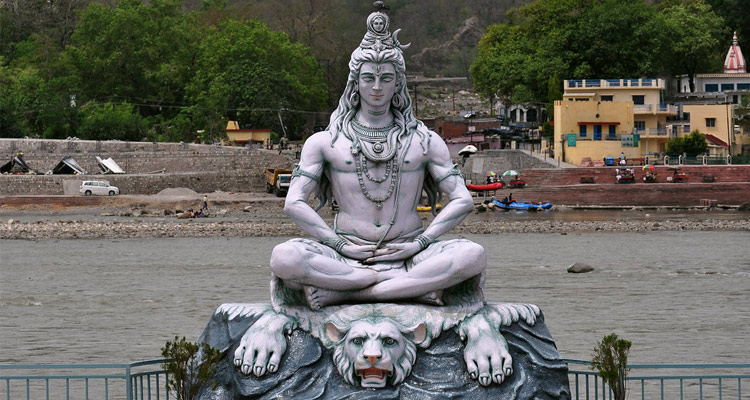
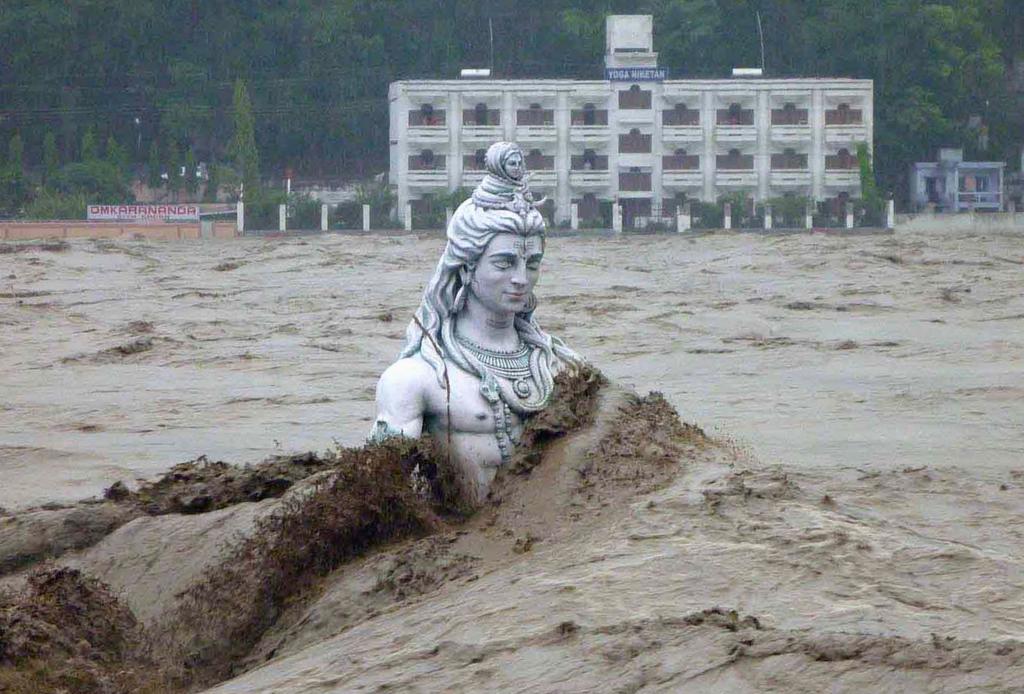
Perhaps more impressive than a headstand is the image of Lord Shiva below, unbothered by the current, completely calm, at ease, in peace.
Relax. Surrender. Enjoy.
 luke fore's personal blog